


MWool®, the next generation of recycled wool by Manteco®
MWool® is the key ingredient of our premium and circular recycled wool textiles
This low-impact and high-end fiber is the result of more than 80 years of circular know-how, innovation and science. We have taken a 200-year old technique and taken it to the next level.
MWool® stands out for an accurate selection and deep testing of the best possible raw materials, a cutting-edge and low-impact mechanical recycling process of pre- and post-consumer garments and scraps, a masterful and dyes-free color creation through our Recype® process, a painstaking quality control and testing, all guaranteed by our MSystem zero-mile and highly specialized supply chain.
MWool® is the first-ever recycled wool with a Life Cycle Assessment that was approved by scientific community, certified according to the EPD® Environmental Product Declaration and scored by the Higg Materials Sustainability Index.
The reasons why MWool® is the next generation of recycled wool
It is as valuable as virgin wool
MWool® is a guarantee in terms of quality and durability, thanks to a great selection and testing of raw materials and a masterful and innovative recycling process. MWool® features all the natural characteristics of virgin wool: it is soft, breathable, elastic, wrinkle, odour and stain resistant; thermo regulating, fire and UV resistant. Plus, all the yarns and fabrics made with MWool® must undergo and pass the same tests as virgin wool fabrics, in order to guarantee the same features, but with the lowest impact possible.
It is fully circular and zero-waste
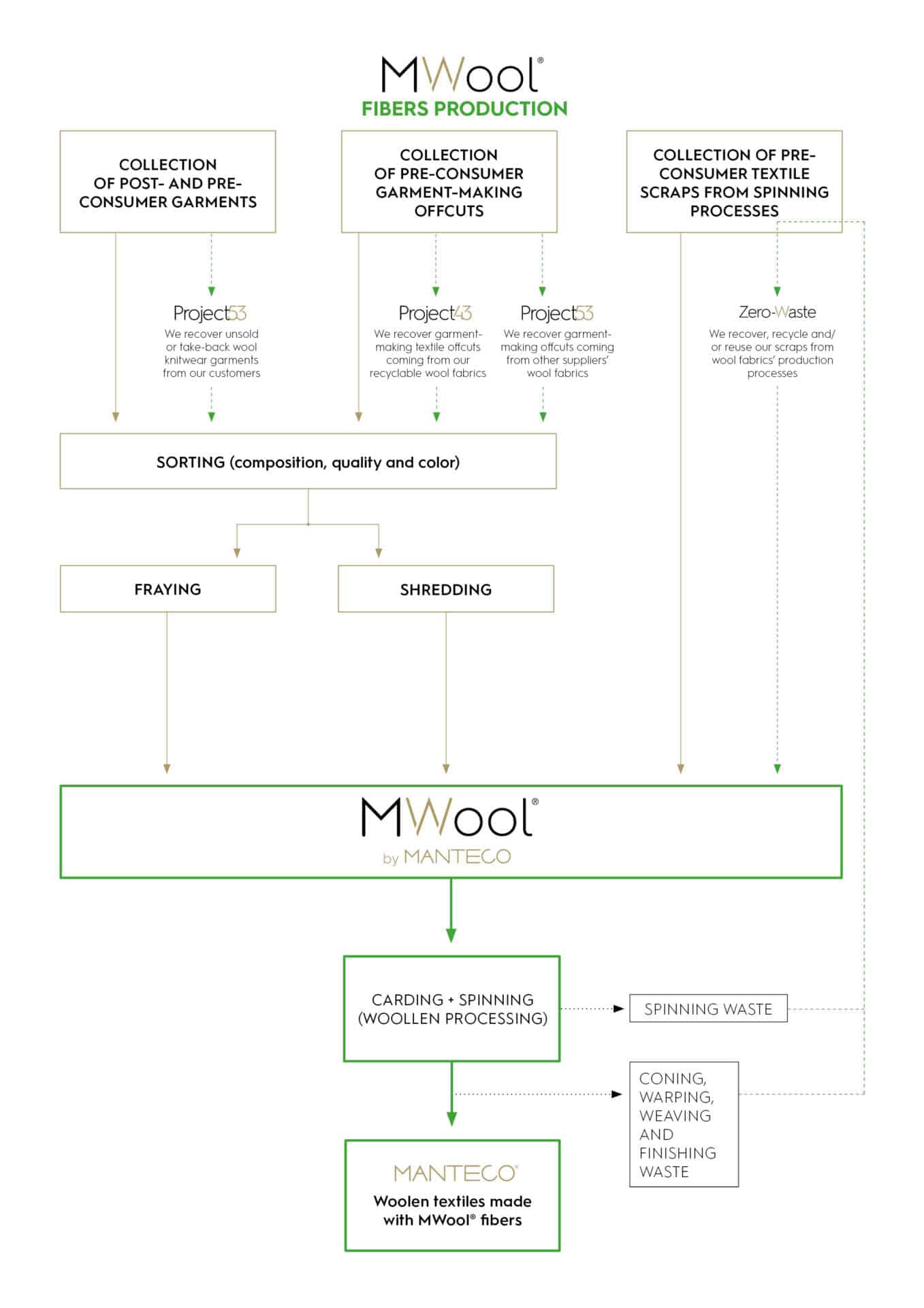
MWool® eliminates the need to use new wool by making the most of what’s already been produced. It is a raw material that fosters an all-round circular economy, as it is made by mechanically recycling industrial waste, pre-consumer scraps and leftovers, and post-consumer garments.
It is Global Recycled Standard-certified
MWool® is GRS-certified. Global Recycled Standard certifies each stage of production to verify recycled content in materials and products, ensuring traceability and respect for social and environmental standards.
It has reduced impacts, compared to generic virgin wool fibers
MWool®, compared to generic virgin wool fibers, impacts 99,2% less on climate change, 99,9% less on water use and 93,3% less on total energy consumption. MWool® fibers’ low impacts were calculated with a life cycle assessment, in accordance with the international standard UNI EN ISO 14040, UNI EN ISO 14044 and UNI EN ISO 14025. This study was also approved by the scientific community and published as a scientific article on MDPI. MWool® fibers’ and fabrics’ low impacts were calculated and certified according to the international EPD® scheme, in accordance with the international standard ISO 14025.
Its impact data is available on major platforms for sustainability evaluations.
MWool® fibers’ low impacts data are also on WORDLY, FAIRLY MADE, CARBONFACT, PEFTRUST and the Textile Exchange’s LCI Library.
It is sustainably colorful, with no added dyes and chemicals
MWool® is available in more than 1000 colors, which are obtained without added chemicals and dyes through our Recype® color creation process, just by mixing numerous and different shades of recycled wool fibers, developing actual ‘recipes’ of no-dye colors, which are archived and adapted to the kgs of yarns that need to be produced.
It is produced in a specialized and local supply chain
MWool® is created and turned into circular, premium textiles within our MSystem supply chain, a unique network of 50+ expert textile businesses located within an area of 10 miles from our headquarter. Our supply chain is in the Prato textile district, in Tuscany, which has been recycling wool since the 1850s and is therefore a guarantee of scalability, reliability and quality.
It is biodegradable in marine environment
After a pioneering study with the Bioscience Research Center (BsRC) and the University of Trieste’s Department of Life Science, we found out that MWool® fibers are biodegradable and do not cause relevant ecotoxicological effects to the marine environment.

MWool® fibers’ life cycle assessment was approved by the scientific community and published as a scientific article
After years of assessments and in-depth studies, we managed to achieve a certified Life Cycle Assessment calculation for our MWool® fibers. Our study, in collaboration with the prestigious Politenico di Torino, develops an environmental analysis of recycled wool fibers through the Life Cycle Assessment (LCA) methodology. A parallel LCA is developed for virgin wool fibers too, in order to obtain a data-based comparison. Deep analyses have been carried out to capture the uncertainty associated with virgin fibers’ impacts and to evaluate how MWool® impacts vary according to the origin and treatment of recycled textiles. Results show that recycled wool fibers have significantly lower environmental impacts than virgin fibers, even when the most unfavorable scenarios are considered. The study was published in the scientific journal Resources (MDPI).
Our MWool® fibers’ Life Cycle Assessment

MWool® yarns’ low impacts were also calculated and certified according to the international EPD® scheme
An EPD® is a certified Environmental Product Declaration, which trasparently reports environmental data over the life cycle of products in accordance with the international standard ISO 14025. MWool® yarns are the first-ever recycled wool yarns to obtain this certification and, since May 27th, 2022, it is available here. Why is the EPD® so important? Because it is based on the international ISO standards, assuring international use, acceptability and continuity; it is based on scientific principles for Life Cycle Assessment (LCA) and approved through independent verification; it is based on specific rules for different product groups (PCR) ensuring that EPDs within the same category of products are calculated and presented in the same way; it provides a tool for communicating additional information such as social responsibility, quality control and environmental management.
Our MWool® yarns’ EPD® – Environmental Product Declaration
Our EPD® – Environmental Product Declaration on MWool® Blend Fabrics
Our EPD® – Environmental Product Declaration on our patented Pure® Fabrics, made of 100% MWool®
Our EPD® – Environmental Product Declaration on our patented Woolten® Fabrics, made of MWool® and Lenzing TENCEL™ Lyocell
Our EPD® – Environmental Product Declaration on our Noble Fabrics, made of MWool® and cashmere
We have carried out an unprecedented marine biodegradability and ecotoxicity scientific study on our MWool® fibers
Pollution of the marine environment by microfibers is widely considered as a problem for the ecosystem, with wastewater from washing machines and the actual wearing of garments as its main sources. A global characterization of microfibers in ocean surface waters revealed that most fibers floating in the world’s oceans are made of cellulose and that the amount of microplastics is less than that of natural fibers. Although they represent less than 2% of global production, 12.3% of microfibers in the samples studied are classified as fibers of animal origin, while cellulose accounts for the majority 79.5%. We decided to create a collaboration with the Bioscience Research Center (BsRC) and the University of Trieste’s Department of Life Science to carry out the first-ever study on recycled wool fibers’ marine biodegradability and ecotoxicity.
MWool® fibers are biodegradable and do not cause relevant ecotoxicological effects to the marine environment! The MWool® fibers’ biodegradability in aquatic environments is a slow – but happening – process due to both the properties of the wool fiber’s structure and the presence of specific physicochemical properties of the marine environment; the results showed that the tested samples did not exhibit relevant ecotoxicological effects during the exposure period on the species (Phaeodactylum tricornutum, Brachionus plicatilis, and Paracentrotus lividus) tested in this study.
Our study was also approved by the scientific community and published as a scientific article in Oceans (MDPI).
Our study of MWool® fibers’ marine biodegradability and ecotoxicity
Frequently asked questions
Is recycled wool as good as virgin wool?
Yes. Mechanically recycled wool keeps the natural features of virgin wool: it is soft, breathable, elastic, thermo-regulating, and resistant to wrinkles, odors and stains. Every yarn and fabric made with Manteco’s MWool® recycled wool must pass the same quality tests as virgin wool fabrics.
How sustainable is recycled wool compared to virgin wool?
Much more sustainable. According to a Life Cycle Assessment carried out with Politecnico di Torino and published on MDPI, Manteco’s MWool® recycled wool has a 99.2% lower impact on climate change than generic virgin wool, 99.9% lower water use and 93.3% lower energy consumption. The results are certified with an EPD® (ISO 14025).
How is recycled wool made?
Wool garments and textile scraps are sorted by color and composition, then mechanically shredded back into fibers, without chemicals. The fibers are blended, carded and spun into new yarns. Manteco has used this process in Prato since 1943, and it creates colors by blending already-dyed fibers, with no added dyes.
How many times can wool be recycled?
Up to 6 times in a closed-loop system, according to a study published in Cleaner Engineering and Technology. Wool keeps more than 92% of its tensile strength after recycling, as long as its fibers stay at least 20 mm long. Shorter fibers can still be reused in other industries.
What does GRS certified recycled wool mean?
It means that an independent body has verified the recycled content of the wool at every stage of production, together with traceability and social and environmental criteria. GRS stands for Global Recycled Standard. Manteco’s MWool® is GRS certified.
The other Manteco fibers


Sign up for Manteco updates
Type your e-mail address and stay up to date on Manteco news, events and initiatives